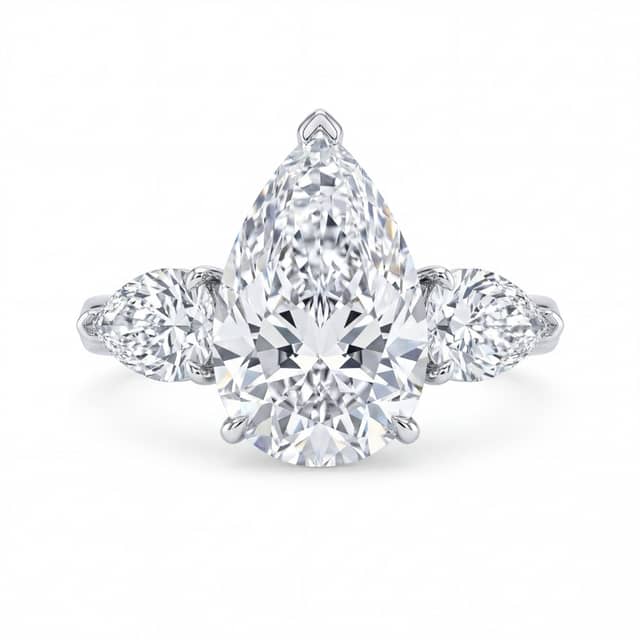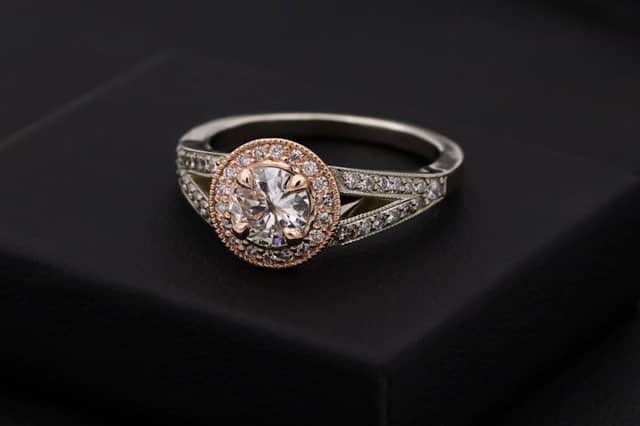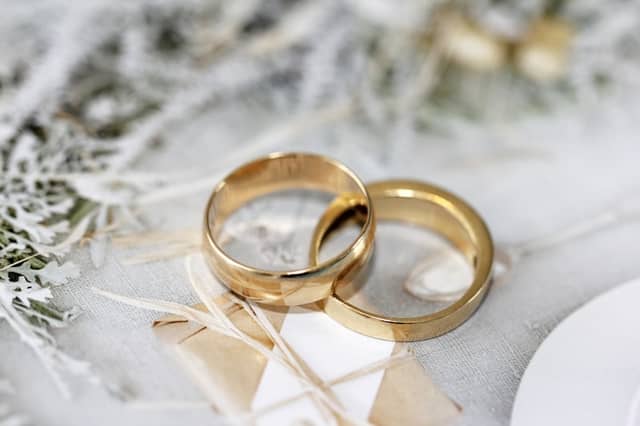
No, your wedding band does not have to match your engagement ring. What matters is that the two sit well together: a band that touches the engagement ring without a gap (or a curved band that follows a pear, marquise or oval), metals you are happy to wear side by side, and a band size you will not need to change if it is set with stones all the way around.
Does your wedding band have to match your engagement ring?
There is no rule, and more couples are mixing. In The Knot's 2026 Real Weddings Study, 88% of couples "made custom edits or custom designed a ring" (The Knot Real Weddings Study 2026), and the band is often where people personalize most. The practical tests are fit, comfort and how the two look on the hand from a normal distance.
Do wedding bands have to match metals?
No, but decide on purpose. Mixed metals are a style choice, and yellow gold is the direction most couples are moving: The Knot found yellow gold on 39% of engagement rings, "up 140% over the last five years, while white gold continues its steady decline." Search interest agrees: in Google Trends for "wedding band" over the last 12 months in the US, "14k yellow gold wedding band" was rising at +500% and "14k gold wedding band" at +190% (pulled October 21, 2026).
Two practical points if you mix. White gold is usually rhodium-plated, and the FTC requires that plating to be disclosed (16 CFR 23.7); it wears with daily contact and needs replating, which you will notice sooner when a white band sits against a yellow one. And whatever the metal, the karat should be stated accurately; the FTC treats misrepresenting "the quantity or karat fineness of gold" as deceptive (16 CFR 23.3). Our engagement rings and bands are 14k gold.
What wedding band goes with a solitaire?
Almost anything. GIA notes a solitaire's "simple design pairs easily with a wide range of wedding bands" (GIA, Guide to Engagement Ring Settings). A plain band keeps the focus on the center stone; a diamond band adds sparkle. For a low-set solitaire, make sure a straight band can sit flush underneath; for a high setting, most straight bands will.
What wedding band matches a pear, marquise, oval or emerald cut?
- Pear and marquise: the point often leaves a gap against a straight band. A curved or notched band follows the outline.
- Oval: a straight band usually works; check the gap at the ends of the stone.
- Emerald and radiant: straight bands suit the clean lines; a band of emerald-cut stones echoes the center.
- Halo: make sure the halo does not overhang the band, or choose a curved band.
The surest test is to try bands against your own ring. Bring it to our Paramus showroom and we will try bands against it, or have one made to follow its outline through custom design.
Can a diamond wedding band be resized later?
It depends on how far the stones go around. GIA notes that channel-set and pavé bands "can be difficult to resize" because adjusting them may disturb the stones (GIA). In our own resizing work, plain bands are simple, bands with pavé all the way around take more care, and full eternity bands are limited or cannot be resized. If you choose an eternity band, get the size measured carefully first; our ring sizing guide explains how.
Lab-grown diamond bands in our collection
As listed on October 21, 2026, our lab-grown diamond bands and eternity rings in 14k gold include:
- 1.12 ct TW lab-grown diamond band, $949.99
- 1.63 ct TW lab-grown eternity ring, $949.99
- 3.20 ct TW lab-grown eternity ring, $1,999.99
- 5.40 ct TW half emerald, half oval eternity ring, $2,399.99
- 6.50 ct TW lab-grown eternity ring, $2,599.99
Shopping for a groom? See our men's wedding band guide. To try bands against your engagement ring, book a visit or call (201) 488-4280.