A three-stone engagement ring sets a center stone between two side stones, and the design is usually read as past, present and future. The questions that matter when you buy one are practical: which shapes pair well, what the carat number on the listing actually covers, and how a wedding band will sit next to it.
What does a three-stone engagement ring mean?
The most common reading is that the two side stones stand for the couple's past and future and the center stone for the present. Some couples use it for an anniversary instead of an engagement, for the same reason. The meaning is tradition, not a rule: plenty of people choose the design simply because a center stone flanked by two smaller ones looks wider and more balanced on the hand than a solitaire.
Which center and side stone shapes go together?
Oval and emerald-cut versions are among the most-searched variations on Google, and each pairing changes the look:
- Round center, round sides. The traditional version; even and symmetrical.
- Oval center, round or pear sides. The oval lengthens the finger; pear side stones pointing outward extend the line further.
- Emerald or radiant center, trapezoid or baguette sides. Straight edges on both, for a cleaner, geometric outline.
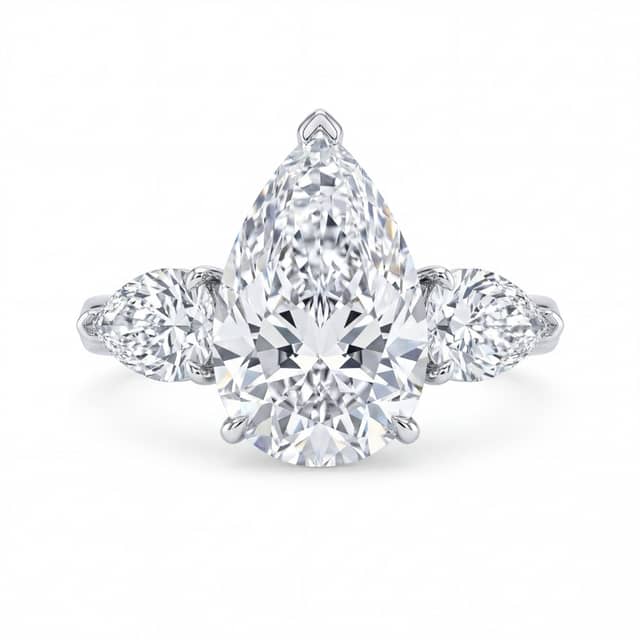
- Pear center, pear sides. Softer and more unusual, like the ring pictured above.
From our own case, the 3.00 ct radiant and trapezoid lab-grown diamond ring pairs a 3.00-carat radiant center with two 0.50-carat trapezoid side stones in 14k gold ($2,099.99 as listed on October 21, 2026). Our diamond shape guide covers how each shape wears on its own.
What does "2 ct TW" mean on a three-stone ring?
"TW" means total weight: the combined weight of all three stones, not the center alone. That distinction is the single most useful thing to check on a listing. Carat is a unit of weight, not size; the FTC's Jewelry Guides put it this way: "A carat is a standard unit of weight for a diamond and is equivalent to 200 milligrams (1/5 gram). A point is one one-hundredth (1/100) of a carat." (16 CFR 23.18)
On the radiant ring above, the stones add up to 3.00 + 0.50 + 0.50 = 4.00 carats, but the center alone is 3.00. A ring advertised only as "2 ct TW" could have a 1-carat center and two half-carat sides, or a 1.5-carat center with two quarter-carat sides: very different rings. Ask for the center weight and each side stone's weight separately.
How big should the side stones be?
There is no fixed ratio, but weight and width do not scale together. Because a stone's width grows roughly with the cube root of its weight, a side stone with one-sixth of the center's weight (0.50 against 3.00 carats) looks a little over half as wide, not one-sixth as wide. That is why side stones that seem small on paper still read clearly on the hand. Choose side stones that are close to the center in color and brightness, so the three read as a set rather than one bright stone and two dull ones.
Are lab-grown diamonds a good choice for a three-stone ring?
Lab-grown diamonds are diamonds: GIA notes they have "the same crystal structure" as natural diamonds, which "results in nearly the same chemical, optical and physical properties" (GIA). For a three-stone ring that matters in two ways: matching three stones is easier when there is a wider supply to choose from, and the budget stretches further across three stones instead of one. Every diamond in our online catalog is lab-grown and named that way; federal guidance requires the qualifier "immediately preceded with equal conspicuousness" before the stone name (16 CFR 23.25). Our article Are lab-grown diamonds real diamonds? goes further.
Will a wedding band sit flush against a three-stone ring?
Often not with a straight band. Three stones across the top usually make the setting wider and sometimes lower at the sides than a solitaire, so a plain band can leave a gap. The fixes are a contoured or notched band shaped around the setting, or a band built to match. Matching wedding bands made to sit flush against an existing engagement ring are one of the custom requests we see regularly; see our custom design service and the wedding band guide. Try the pair together before you commit.
Can I turn a solitaire into a three-stone ring later?
Yes. Adding two side stones to an existing solitaire, usually for an anniversary, is a common way to keep the original center stone while updating the ring. It is a custom job: the setting is rebuilt around the stone you already own. Our guide to upgrading an engagement ring walks through it.
See three-stone rings in Paramus
Browse our lab-grown diamond rings, or book a private appointment at our showroom inside The Jewelry Center on Route 4 to compare shapes on your own hand.
Prestige Diamonds NJ
327 E State Route 4, Paramus, NJ 07652
(201) 488-4280